ADVERTISEMENT
You will be redirected to your destination in 10 seconds.
Electronics Industry Search

Polling Question

Should the government bail out U.S. automakers?

  • Yes
  • No


View Previous Poll Results
Advertisement

Link This | Email this | Blog This | Comments (0)

ABB Automation World Highlights

March 22, 2007

ABB's Automation World Conference and Exhibition draws to a close in Orlando, FL, today, and the event gave more than 2,500 attendees a chance to check out the company's latest developments in control systems, drives, motors, robotics and more. Here are some highlights: 

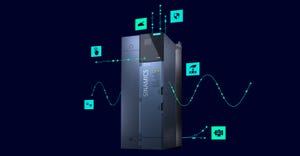
Sharp-eyed attendees got to see a North American preview of the company's new ACSM1 drives, which debuted at last year's Hannover Fair. These drives, which cover a power range from 1 to 60 HP, extend the capabilities of the company's line of machinery drives by adding position control to the speed and torque control offered by previous drives. "The M1 is intended for all those applications that need some position control but don't need a full-blown servo amplifier," says Cliff Cole, ABB's marketing director for low-voltage drives. The M1 drives will see a limited roll out in this country later in the year. Until then, you can check more details on the drive on this ABB site in Ireland. 

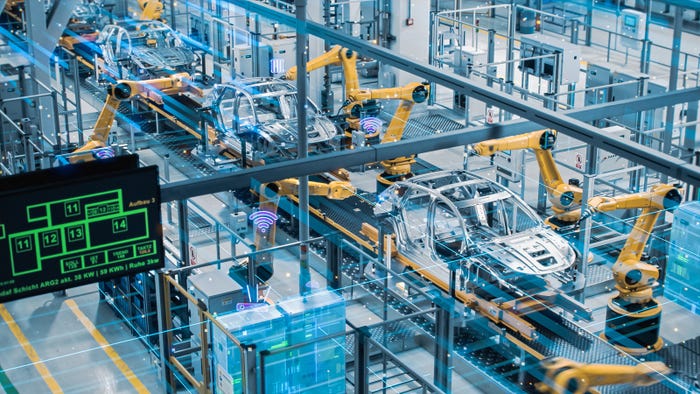
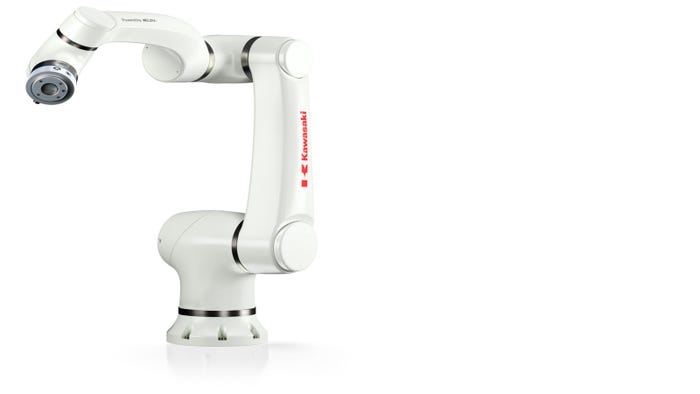
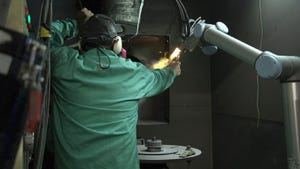
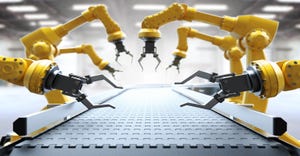
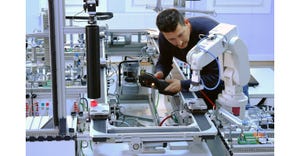
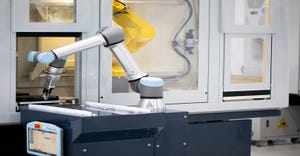
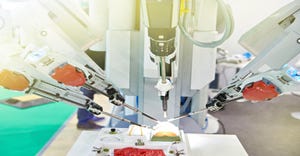
Robotics were another hot topic at the conference. During a round table discussion with ABB executives, Kirk Goins, senior vice president of the robotics division, noted that North America has one of the lowest "robot densities"  among industrialized nations. And he pointed out two emerging technologies that promise to drive more growth. One is robotic vision, or using machine vision to help position robots in 3D space. And the other is advanced force control, an ABB technology that gives robots the ability to sense and adjust the forces they exert. Think of these technologies as allowing robots to "see" and "feel," which in turn opens up assembly, machining and finishing applications that previously caused trouble for robots.  Robotic vision, for example, lets very precise robots tolerate parts that are inconsistently located or have size variations–and do so without expensive fixtures. And force control got its start as a way to install various geared automotive components–the robot needs to feel when gears mesh. Lately, the biggest use for the technology has been in machining and finishing operations–including the polishing of magnesium laptop housings.

Finally, the show was a good place to get a look at ABB's growing portfolio of wireless technologies. The company brought new wireless adapters compatible with the HART-protocol for field instrument communications. It also showed a prototype line of wireless vibration sensors for rotary equipment. The company also showed off its WISA technology, which not only provide real-time communications wirelessly but also offers a wireless power supply via a 120 kHz magnetic field. Mark Woudenberg, business development manager for wireless I/O,  notes that the technology has been around since 2003 as a commercial product, but it hadn't until recently found applications in the U.S.  For the past five months, though, WISA enabled sensors have seen use used for die verification in a Ford Motor Company stamping plant, Woudenberg says. Other promising applications include end-of-arm sensors for industrial robots, which can be difficult to cable.

Posted by Joseph Ogando on March 22, 2007 | Comments (0)
Industries:
POST A COMMENT
Display Name
captcha

Before submitting this form, please type the code above:

Advertisement
Advertisement

Design News Partner Zones

AnarkCAD/CAE Model Clean-Up: Reduce Iterative Cycles
This webinar featured research and survey results related to problems associated with preparing CAD geometry for CAE applications.  We discussed how Recipe-Based Automation can help create "just-in-time" CAE-ready geometry each time a cad model is updated. Watch the Presentation


Light Matters: Systems Level Approach to HBLED illumination applications
Its good practice to apply a systems-level approach to high-brightness LED (HBLED) illumination applications. Minimally, the system includes the optical, thermal and electrical characteristics of the of the HBLED, the lens (if any) which is built-in to its package, secondary optics such as external plastic lenses/reflectors to direct the light as your application requires and power driver electronics. Read More


Design Engineers' Portal for Sensing and Machine Safety
Whatever industry you're in, or whatever product you manufacture, the right sensors to automate your plant, and to improve your overall efficiency, quality and safety are a must. You'll find Banner Engineering to be an amazing resource of products, training and people with expertise.

Design News Partner Zone Directory »

Please visit these other Reed Business sites