Skip navigation
Electronics Industry Search
Advertisement
RSS
Reprints/License
Print
Email

Robotic Jellyfish Swim and Fly at Hannover Fair

Joseph Ogando, Senior Editor -- Design News, April 22, 2008

The biggest draws at Festo’sHannover Fair exhibits have been biologically inspired robotic creatures that show off cutting-edge automation technologies. Turning once again to nature for inspiration, the company’s engineers this year came up with robotic jellyfish that either swim or fly.

They may look whimsical, but the waterborne AquaJelly and airborne AirJelly make use of mechatronic design practices, control strategies and actuation methods that could have serious engineering implications. According to Markus Fischer, Festo’s head of corporate design, these robots have a degree of autonomy and adaptive behavior that “will be very useful in the factory of the future.”

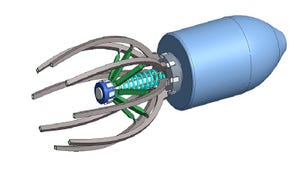
Both the AquaJelly and AirJelly share a basic construction that consists of a sphere-shaped body with eight electrically driven tentacles for propulsion. Both run off rechargeable lithium-ion batteries and are powered by 3V coreless motors. Given the differing mediums in which they travel, the two robots do have different bodies — a laser-sintered pressure vessel for the AquaJelly and a helium balloon measuring 1.35m across for the AirJelly.

Their tentacle construction takes its cues from the functional anatomy of some fish fins. These bio-inspired tentacles consist of two flexible external surfaces connected by a series of internal ribs. When one of the surfaces is put under tension, the entire tentacle bends in the direction of the applied force — a phenomenon that Festo calls the “fin ray effect.” Festo uses an electric drive, geared power transmission and linkages to actuate the tentacles. Alternating tension between the two external surfaces creates a wave-like motion that propels the robots through the water or air. Fischer describes the resulting movement as “peristaltic” since the waving tentacles seem to move by something like muscle contractions. Whether they swim or fly, these two types of jellyfish steer themselves by carefully controlled weight shifts. As Fischer explains, their bodies contain a servo-driven swash plate connected to a four-armed pendulum that changes their center of gravity. “The pendulum shifts their weight, and they move in a new direction,” he says. And for the AquaJelly in particular, that new direction is determined autonomously. This underwater robot guides itself with the help of a sensor array, communications systems and control software based on robotic swarm-intelligence. Fischer notes, for example, multiple AquaJelly robots can avoid each other in the water, using light sensors to pick up the presence of their tank mates. They also have pressure sensors that allow them to gauge their depth within a few mm. AquaJelly robots also manage their own battery-charging behavior. They communicate with an in-tank charging dock wirelessly via ZigBee, for example, to make sure the dock isn’t occupied when they need to charge. According to Fischer, giving these robots such a high degree of autonomy required a mechatronic approach in which the mechanical design, sensor engineering and control software were all developed concurrently. “Even simple autonomy is not so simple,” he says.

Advertisement

Sponsored Content

Technology Marketplace

video icon Watch more videos at DN’s Video Library!

Gallery »

Robotic Jellyfish Swim and Fly at Hannover Fair

RSS
Reprints/License
Print
Email
Find a supplier on oemsuppliersearch.com

Talkback
Advertisement
Reed Business Information Resource Center

Featured Company


Advertisement

Design News Partner Zones

Light Matters: The Unsung Heroes of Modern Health Care
First, let's define "no-compromise." In an ideal configuration, this lamp would use a high-brightness LED (HBLED) that is built into a small, integrated package and is able to produce a large quantity of focused light, operate with a high level of reliability and generate no audible noise. Is this difficult? Yes, but it is possible.
Read More


Design Engineers' Portal for Sensing and Machine Safety
Whatever industry you're in, or whatever product you manufacture, the right sensors to automate your plant, and to improve your overall efficiency, quality and safety are a must. You'll find Banner Engineering to be an amazing resource of products, training and people with expertise.


Test & Measurement World Machine Vision & Inspection Report
Topics include machine-vision software, Power over Camera Link, thermal imaging and frame grabbers. Read More

Design News Partner Zone Directory »

Please visit these other Reed Business sites