Skip navigation
Electronics Industry Search
Advertisement
Email
Print
Reprints/License
RSS

MIT Moves Forward with Smart Cities and Stackable Cars

MIT’s Media Lab redesigns the automobile as a shared-use city car based on developments in robotic wheel technology

Sean Snyder, Associate Editor -- Design News, May 15, 2007

MIT, a longtime leader in technology and innovation, is now challenging the existing system of the city, as well as automobile design with Smart Cities Concept Cars.

The designers behind Concept Cars have re-evaluated the use and function of cars in the city with new designs that remove the drive train and put precedence on robotic wheels. “We reinvented the wheel, or actually, we rethought it,” says Mitchell Joachim, former MIT student and current Smart Cities committee member.

Students, professors, professionals and partners collaborated on the cars under the guidance of Professor William J. Mitchell. The project is based in transology, a field of design concerned with the interrelationship of mobility and the environment. The Concept Cars system is designed to connect new and efficiently designed cars to each other and their environment (the city).

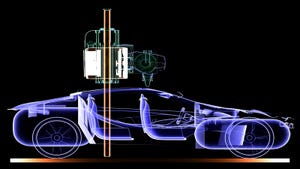
Each wheel includes an electric drive motor, steering, braking, suspension and embedded intelligence to create a piece that is independent from the whole car. “The wheel is the whole car,” says Joachim, “but you add volume to include people.”

One innovative Concept Car design is the stackable car. The stackable car is an electric car that sits at charging terminals throughout the city with a user base similar to that of the Zipcar. The goal of the project is to have the cars integrated with public and personal transportation to accommodate the system rather than replace it.

The cars are designed with a collapsible frame for stacking, wireless control, integrated mapping and an evolved interface for steering and navigation. The wheels will have a potential rotation of 150 degrees or, if they are independent from the car, a full 360 degrees.

Included in the project proposal is a planned system for power and charging including solar panels, wind generated energy and hydrogen fuel, but for now focus remains on the cars and their robotic wheels. “We are pushing a different architecture because of the robotic wheels,” says student Ryan Chin. “We could even get rid of traditional brakes because we can reverse the direction of the motor.”

The next step for Smart Cities is implementation. Chin and his team hope to have the project developed within two years. “The project is going to move forward as a real project, not just a paper project,” says Chin.

Issues of need, use and desire accompany any project. “We are trying to figure out how the car will be received by the real world,” says Chin. But with sponsors like General Motors, Motorola and MIT, there are enough interested parties to help these cars and systems succeed.

Media Lab’s Stackable Cars outside a subway station conveniently positioned to accommodate public transportation. Photo Franco Vairani.
Find a supplier on oemsuppliersearch.com
Products/Services Companies
Advertisement

Sponsored Content

Technology Marketplace

Email
Print
Reprints/License
RSS
Find a supplier on oemsuppliersearch.com

Talkback
Advertisement
Reed Business Information Resource Center

Featured Company


Advertisement

Design News Partner Zones

Light Matters: The Unsung Heroes of Modern Health Care
First, let's define "no-compromise." In an ideal configuration, this lamp would use a high-brightness LED (HBLED) that is built into a small, integrated package and is able to produce a large quantity of focused light, operate with a high level of reliability and generate no audible noise. Is this difficult? Yes, but it is possible.
Read More


Design Engineers' Portal for Sensing and Machine Safety
Whatever industry you're in, or whatever product you manufacture, the right sensors to automate your plant, and to improve your overall efficiency, quality and safety are a must. You'll find Banner Engineering to be an amazing resource of products, training and people with expertise.


Test & Measurement World Machine Vision & Inspection Report
Topics include machine-vision software, Power over Camera Link, thermal imaging and frame grabbers. Read More

Design News Partner Zone Directory »

Please visit these other Reed Business sites