ADVERTISEMENT
You will be redirected to your destination in 10 seconds.
Electronics Industry Search

Polling Question

Should the government bail out U.S. automakers?

  • Yes
  • No


View Previous Poll Results
Advertisement

Link This | Email this | Blog This | Comments (0)

3D Printing and Rapid Manufacturing In the Spotlight At Rapid 2007

May 1, 2007

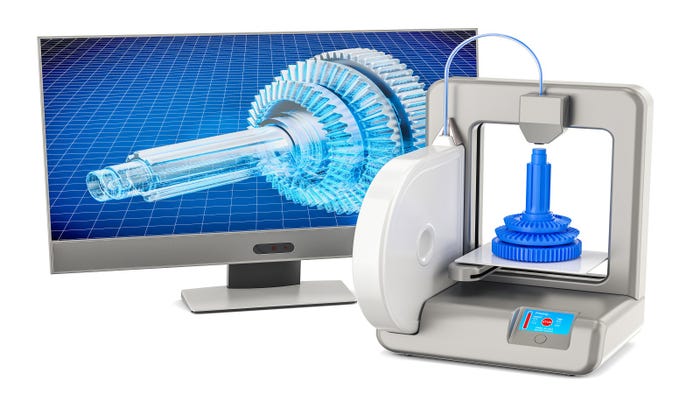
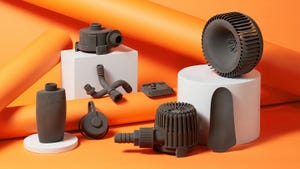
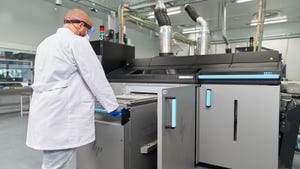
Rapid 2007, the annual conference and show for the rapid prototyping industry, began today in Detroit with an emphasis on two technology trends that will increasingly change how design engineers do their jobs. One is the huge growth of relatively low-cost 3D printers, which continues to make rapid prototyping accessible to a broader range of engineering organizations. The other has to do with rapid manufacturing technologies becoming ever more commercially viable.

3D printing now represents 49.8 percent of all additive rapid prototyping systems installed worldwide through the end of 2006, according to Terry Wohlers, a consultant who publishes a well-respected prototyping industry study called the Wohlers Report. He kicked off Rapid 2007 with an overview of the entire prototyping industry. And while other types of additive machines and prototyping materials continue to post healthy growth too, 3D printers have pulled way ahead from a units-sold standpoint. Wohlers reports that 3D printers accounted for 72.5 percent of all additive systems sold in 2006, up from 70.3 percent in 2005 and 68.3 percent in 2004.


Good prototyping functionality at low system prices are no doubt behind the popularity of these 3D printing machines. And 3D printers seem to cost less all the time. Consider that a few 3D printing systems have over the past few years dipped below $20,000. Now, a new entry to the 3D printing market, from a company called Desktop Factory, costs just $5,000. It uses an inexpensive halogen light source and drum printing mechanism to build plastic composite parts in a 5×5x5 inch build envelope.

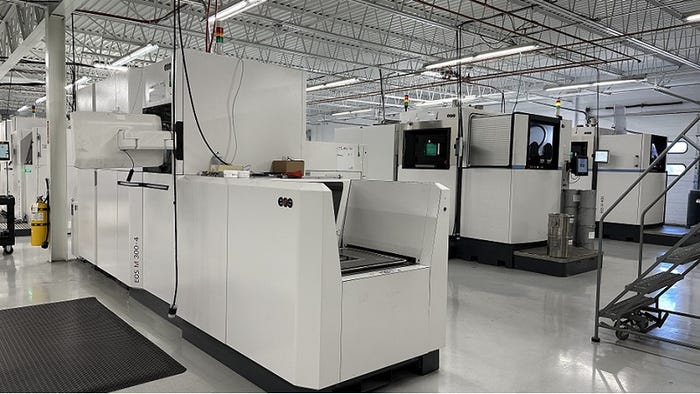
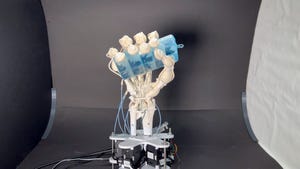
On the other end of the prototyping spectrum are expensive additive machines capable of manufacturing tight-tolerance plastic or metal production parts—a field that's variously called rapid manufacturing, direct digital manufacturing, or even e-manufacturing. Whatever you call it, this use of additive fabrication systems continues to grow. EOS, the leading maker of laser sintering machines, recently used 23 laser-sintered plastic parts on its latest machine, the Formiga P 100. Think of this effort as a modest step toward self-replicating machines.

Another ongoing rapid manufacturing efforts include almost 70 SLS parts in Boeing’s F18 program. And the racing industry has adopted the technology too. In his talk this morning, Wohlers noted that Renault's F1 team goes through more than 900 rapid manufactured parts per racing season.

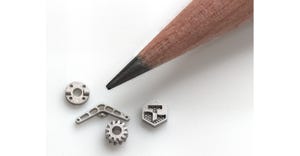
Now, the ability of additive systems to accommodate more metals—including stainless steel, cobalt chrome, titanium and, soon, Inconel—is promising to further boost rapid manufacturing. Dr. Brent Stucker, a Utah State University mechanical and aerospace engineering professor, notes that the ongoing development of metal alloys for prototyping systems means that engineers will have to make fewer compromises when considering whether to adopt the technology. “Metal rapid prototyping in the alloy of choice has moved from the lab out onto the manufacturing floor,” he says. “This is the first year I feel comfortable saying that.”

Check back over the next few days for more about 3D printing, rapid manufacturing and other topics from Rapid 2007.

Posted by Joseph Ogando on May 1, 2007 | Comments (0)
Industries:
POST A COMMENT
Display Name
captcha

Before submitting this form, please type the code above:

Advertisement
Advertisement

Design News Partner Zones

AnarkCAD/CAE Model Clean-Up: Reduce Iterative Cycles
This webinar featured research and survey results related to problems associated with preparing CAD geometry for CAE applications.  We discussed how Recipe-Based Automation can help create "just-in-time" CAE-ready geometry each time a cad model is updated. Watch the Presentation


Light Matters: Systems Level Approach to HBLED illumination applications
Its good practice to apply a systems-level approach to high-brightness LED (HBLED) illumination applications. Minimally, the system includes the optical, thermal and electrical characteristics of the of the HBLED, the lens (if any) which is built-in to its package, secondary optics such as external plastic lenses/reflectors to direct the light as your application requires and power driver electronics. Read More


Design Engineers' Portal for Sensing and Machine Safety
Whatever industry you're in, or whatever product you manufacture, the right sensors to automate your plant, and to improve your overall efficiency, quality and safety are a must. You'll find Banner Engineering to be an amazing resource of products, training and people with expertise.

Design News Partner Zone Directory »

Please visit these other Reed Business sites