ADVERTISEMENT
You will be redirected to your destination in 10 seconds.
Electronics Industry Search

Polling Question

Should the government bail out U.S. automakers?

  • Yes
  • No


View Previous Poll Results
Advertisement

Link This | Email this | Blog This | Comments (2)

GM Will Use New Structural Adhesives Extensively

March 24, 2008

New models based on General Motors Delta and Epsilon platforms will make extensive use of new crash-resistant structural adhesives.mOne example is expected to be the 2009 Daewoo/Chevrolet compact sedan, although General Motors will not make comments about future designs until vehicles are released. The new adhesives improve the crash worthiness of cars and also allow use of thinner gauges of steel. The new generation of structural adhesives has a crash resistance that is more than ten times higher than conventional reinforcing adhesives.


Adhesive bonding in cars has a long history including the bonding of glass into the body flange. Bodies represent 25 percent of a car’s weight and are key targets for weight savings. Until recent years, however, high-strength adhesives used in aircraft and other applications were not suitable for car bodies because they were brittle in crash situations, particularly at low temperatures.


New technical breakthroughs came with the development of a two-stage system that modifies impact resistance. A chemical reaction creates toughened particles and a flexibilizer in a process called synergistic rubber toughening. The toughened particles reduce fracturing and absorb energy. Soft particles, only a few nanometers in size, are uniformly distributed throughout the matrix before curing of the adhesive. 
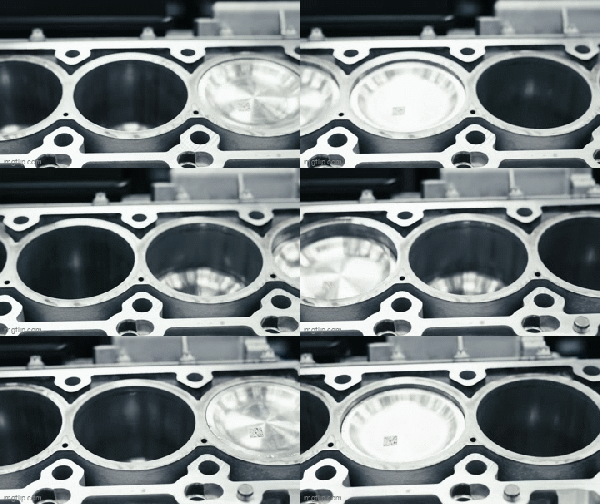
 

Another important development came when adhesives producers developed grades that are compatible with existing automotive production lines. The new grades typically cure at temperatures around 356°F, allowing the electro coat process to cure the structure without a dedicated curing oven. The newest of the materials can be used in temperatures ranges from minus 40 to 176°F.


Two leaders in the field are Henkel and Dow Automotive. Another factor is that the adhesives enhance new high-strength steels. The new adhesives improve seam integrity by providing a dual energy management system. High-strength steels don’t yield very much so energy often is pushed to point of the spot weld, unless the adhesives are used.


“So far, the new adhesives have been used mostly as an enhancement to spot welding,” comments Chris Liddiard, a director of structural solutions for Henkel North America. “The trend we see going forward is the gauge reduction. A lot of these applications are in development now.”

Posted by Doug Smock on March 24, 2008 | Comments (2)
Industries:

April 10, 2008
In response to: GM Will Use New Structural Adhesives Extensively
Dow Automotive commented:

Your question is very valid and I understand the concerns. I am global market manager with Dow Automotive for structural solutions. Structural adhesives undergo intensive testing at OEMs for impact, corrosion, heat/humidity resistance and fatique performance before they are released and used. The general observation is that structural adhesives significantly reduce the effect of application property loss after ageing in stead of creating an additional risk. This is all related to a better stress distribution in load cases when using structural adhesives. Especially with so called crash durable adhesives, very high loads can be transferred. There are many structural adhesive applications in premium european vehicles that date back up to 10 years when the technology was introduced. Based on this long term and positive experience the use of structural adhesives in the automotive industry continues to grow strongly. For repair solutions complete parts that are pre-bonded at the OEM will be replaced or in other cases damaged sections will be cut out and replaced by using 2 component room temperature cure adhesives.


April 7, 2008
In response to: GM Will Use New Structural Adhesives Extensively
donb commented:

Two questions: 1. How well will these adhesives hold up through 10 to 20 years of shock, vibration, thermal cycling, humidity, etc? 2. What will body shops use for crash repairs of adhesive-bonded areas?

POST A COMMENT
Display Name
captcha

Before submitting this form, please type the code above:

Advertisement
Advertisement

Design News Partner Zones

AnarkCAD/CAE Model Clean-Up: Reduce Iterative Cycles
This webinar featured research and survey results related to problems associated with preparing CAD geometry for CAE applications.  We discussed how Recipe-Based Automation can help create "just-in-time" CAE-ready geometry each time a cad model is updated. Watch the Presentation


Light Matters: Systems Level Approach to HBLED illumination applications
Its good practice to apply a systems-level approach to high-brightness LED (HBLED) illumination applications. Minimally, the system includes the optical, thermal and electrical characteristics of the of the HBLED, the lens (if any) which is built-in to its package, secondary optics such as external plastic lenses/reflectors to direct the light as your application requires and power driver electronics. Read More


Design Engineers' Portal for Sensing and Machine Safety
Whatever industry you're in, or whatever product you manufacture, the right sensors to automate your plant, and to improve your overall efficiency, quality and safety are a must. You'll find Banner Engineering to be an amazing resource of products, training and people with expertise.

Design News Partner Zone Directory »

Please visit these other Reed Business sites