Ask Dieter Ramsauer his official title, and he responds “engineer.” That’s interesting, because he founded and is president of a $60 million assembly company based near Düsseldorf, Germany.
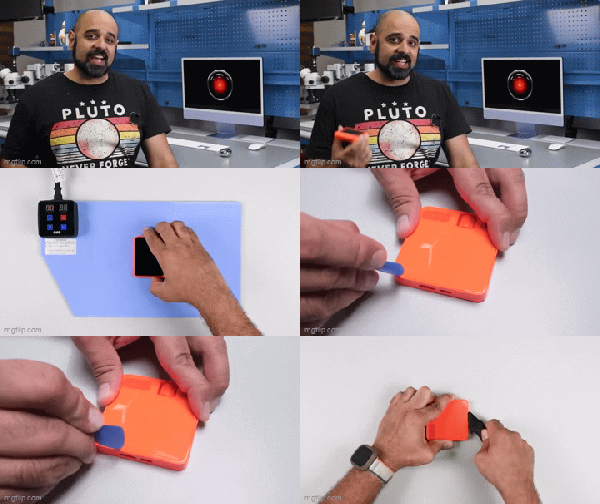
The 68-year-old Ramsauer was trained as a toolmaker in the prestigious German technical system, later became an applications engineer, founded Dirak in 1991 and in 2004 developed a new assembly approach called SnapLine that uses snap-fit parts to reduce assembly time for sheet-metal enclosures.
Ramsauer spends at least half his time in engineering product development and has racked up more than 250 patents in fastening systems. The two keys to success in engineering, in Ramsauer’s view, are practical, hands-on knowledge of how materials can be shaped and used and closeness to customer requirements.
“When I first showed people the SnapLine products, many said it could not work because they didn’t really understand what the materials could do. Or they thought it would be too expensive,” says Ramsauer.
The basis for the snap technology is straightforward. It works on the same principle as a door’s spring lock. A beveled spring bolt is pushed against the pressure of the spring, past the edge of the striking plate in the door frame and into a guide channel when a door is closed. As soon as the spring bolt passes the edge of the striking plate, it springs out of the guide channel. The force of the tensioned spring inserts it into the striking plate, which securely locks the door. Not until activation of the latch is the spring bolt pulled out from the striking plate and back into the guide channel so the door can be opened.
At the core of Ramsauer’s snap fastening system are two parts — the guide and the spring seating in a cutout within the guide. The guide includes single or multiple triangular wings at the ends which are defined by the wing pitch and clamping pitch. The key to making it work is the materials’ technology. One piece is made from powder metal and the other is either a zinc die casting or an exotic plastic, 40 to 50 percent glass-reinforced polyimide. The plastic in particular is a tough material to mold and this is where Ramsauer’s knowledge of tool construction came into play. Polyimides are high-performance polymers known for their strength, as well as chemical and thermal resistance. The parts are obtained by Dirak through a global supply chain.
There are 15 design engineers at Dirak and Ramsauer looks for engineers who “have a feeling for the materials” based on practical experience. Ramsauer has spent virtually his entire career designing locking systems for enclosures and designed his first modular system in 1967. “It was a great relief for electrical cabinet makers when they could use one cut-out for different types of locks,” says Ramsauer. “They could start to standardize their cabinets.”
Productivity enhancement also played a big role in development of the snap-fit approach. “I designed it because the enclosure manufacturers had built up their sheet-metal capabilities to a point where the assembly of the parts could no longer keep up,” says Ramsauer. At first he investigated simplified assembly systems based on reduction of fasteners. “So then I said, I will not go for just two screws, I will go for no screws,” he says.
Ramsauer also demonstrates that engineers can make excellent business people. Dirak grows consistently 25 to 30 percent a year funded through internal capital.
Ramsauer Patent Sampler
1981 Swinghandle
1986 Modular system
1989 4-lip seals for optimal sealing of doors and panel
1990 Rod-latch system for flat rods
1991 Hinge 180° with one swivel
1994 Hinge with open oblong hole
1998 Quarter turn with compression
1999 Mounting system with pre-assembled clip
2000 Modular cylinder
2001 Swinghandle with override
2002 Slam Latch
2004 Concealed hinge lift-off
2004 D-SNAP technology
2006 Dual-cylinder swinghandle
2007 Oscillating lock with an extra-long compression
Dieter Ramsauer invented snap-fit assembly to speed enclosure manufacturing.
Clippard Instrument Laboratory |
Product Brief VIEW NOW
SPONSORED CONTENT
ADVERTISEMENT
Design News Partner Zone
Mechatronics in action
Successful synergistic integration of controls, electronics, computers and mechanical systems is key to the 21st century design process. Unlock the secrets at the new Mechatronics Zone!
Webcast: Sensor Know-How Now
Join our moderator Randy Frank and John Keating from Cognex and explore Solving Industrial Inspection Problems. Read More