ADVERTISEMENT
You will be redirected to your destination in 10 seconds.
Electronics Industry Search

Polling Question

Should the government bail out U.S. automakers?

  • Yes
  • No


View Previous Poll Results
Advertisement
Email
Print
Reprints/License
RSS
Article tools sponsored by

GM Shows Off Autonomous Vehicle at CES

Sensors, computers enable vehicle to brake, steer, avoid obstacles

Charles J. Murray, Senior Technical Editor -- Design News, January 9, 2008

General Motors Corp. this week provided attendees at the 2008 Consumer Electronics Show (CES) a glimpse of the future, giving them a chance to ride in the robotic driverless vehicle that won the Defense Advanced Research Project Agency’s (DARPA) 60-mile Urban Challenge race in November.

Known as “Boss,” the high-tech Chevrolet Tahoe employs LIDAR, radar, GPS and a computing platform that’s essentially a “supercomputer on wheels” to autonomously brake, steer, accelerate and “see” obstacles in the road. CES attendees were allowed to ride in the passenger seat of the vehicle as it navigated a designated path in a parking lot across the street from the show’s main hall.

GM and a team of engineers from Carnegie Mellon University, Continental Automotive Systems, Caterpillar, Inc. and a host of other companies designed the vehicle and dubbed it “Boss” in honor of GM’s research and development founder, Charles F. Kettering.

GM engineers at the show said the vehicle is more than a glitzy technical curiosity. “It’s aligned with our vision,” said Bakhtiar Litkouhi, manager of vehicle control systems for GM’s Electrical and Controls Integration Laboratory. “It’s very important from a customer and safety point of view.”

Litkouhi added 75 percent of today’s accidents are caused by driver behavior. Meanwhile, roads are getting more crowded and today’s total of 850 million vehicles is expected to grow to more than a billion as China and India begin to buy more cars.

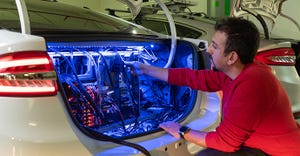
Boss could help solve the problem by taking driver behavior out of the picture. The prototype vehicle incorporates technology from a wide variety of sensor manufacturers and computer companies. A rotating LIDAR system from Velodyne is mounted atop the vehicle. Boss also employs Continental radar systems and planar lasers from Sick Optic, along with three GPS antennae on the roof. Inside, it uses a CompactPCI chassis packed with 10 computing blades, each containing an Intel Core 2 Duo processor and 10 Gbytes of memory.

“You have the equivalent of about 20 laptop processors working in there,” said Bob Bittner, Tartan Racing test lead for Carnegie Mellon.

The vehicle uses the huge computing platform to run “sensor fusion” software to enable the vehicle to understand what it is “seeing.”

“You’ve got a lot of different sensors seeing the same thing, and they all see the same thing differently,” Bittner said. “So you have to use the sensor fusion to enable the vehicle to make sense of it all.”

In the CES parking lot, the vehicle used a GPS-based map of the course, then did the accelerating, braking and steering by itself. GM engineers placed garbage cans in the roadway and drove other vehicles across its path at stop signs to show that Boss was capable of reacting to the unexpected.

Engineers at the show said the technology will begin as an adjunct to the driver, but will eventually become completely autonomous. Litkouhi estimated that complete autonomy could arrive as soon as 2020.

“There’s a lot of computing power on board, but from a production (integration) standpoint, we can eliminate a lot of the computing systems and sensors,” Litkouhi said. “We can clearly see an evolutionary path to full autonomous vehicles.”

Read more about how DARPA robot cars like "Boss" could improve driver assistance systems in passenger cars and trucks.

GM showed off the winning vehicle from the DARPA Urban Challenge at CES.
Advertisement

Sponsored Content

Technology Marketplace

Email
Print
Reprints/License
RSS
Article tools sponsored by
Find a supplier on oemsuppliersearch.com

Talkback


We would love your feedback!


» Submit talk back
Advertisement

DN's Resource Center Get Free Information, Made Easy

Advertisement

Design News Partner Zones

AnarkCAD/CAE Model Clean-Up: Reduce Iterative Cycles
This webinar featured research and survey results related to problems associated with preparing CAD geometry for CAE applications.  We discussed how Recipe-Based Automation can help create "just-in-time" CAE-ready geometry each time a cad model is updated. Watch the Presentation


Light Matters: Systems Level Approach to HBLED illumination applications
Its good practice to apply a systems-level approach to high-brightness LED (HBLED) illumination applications. Minimally, the system includes the optical, thermal and electrical characteristics of the of the HBLED, the lens (if any) which is built-in to its package, secondary optics such as external plastic lenses/reflectors to direct the light as your application requires and power driver electronics. Read More


Design Engineers' Portal for Sensing and Machine Safety
Whatever industry you're in, or whatever product you manufacture, the right sensors to automate your plant, and to improve your overall efficiency, quality and safety are a must. You'll find Banner Engineering to be an amazing resource of products, training and people with expertise.

Design News Partner Zone Directory »

Please visit these other Reed Business sites