Automotive Multimedia's Next Step
Copper may offer a solution for next-generation vehicles loaded with navigation systems, DVD displays, and real-time cameras
Chuck Murray, Senior Technical Editor -- Design News, June 5, 2006
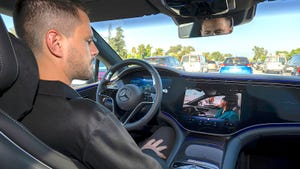
A decade ago, no one could have dreamed that automakers might one day be facing a multimedia dilemma. It's happening, though, as engineers lay plans to equip vehicles with multiple electronic displays, and then connect those displays to DVD players, navigation systems and cameras. According to this vision, tomorrow's cars will have video bits zipping around them from front-, side- and rear-mounted cameras; they'll have signals from GPS satellites popping up on dashboard displays; and they'll have Arnold Schwarzenegger vying with Reese Witherspoon on multiple rear-seat screens.
It's the automotive world's version of video overload, and it's coming to a vehicle near you.
Before it gets there, though, automakers and vendors need to work on ways to make it all happen. Up until now, the solution has been straightforward: Slide a DVD player in the dash and run some discrete wiring through the roof to the rear. That, however, won't cut it in the bit-gobbling multimedia world. It's simply too much wiring and not enough bandwidth.
"You need a network with multiple channels and very high bandwidth for these applications," notes Ricardo Wong, assistant manager for multimedia planning in Nissan's Advanced Engineering Center. "We have to develop an infrastructure to solve the (wiring) harness complexities."
Indeed, wiring harness problems are at the heart of the issue, in large part because there's already a bunch of specialized vehicle networks waiting in the wings for safety systems, drive-by-wire systems, lighting, seats and door locks. And, oh yes, there's also today's old standby — the Controller Area Network (CAN) — which does virtually everything else. So the multimedia bus — in whatever form it may take — is yet another network waiting to share space inside an already-crowded auto body.
Among automakers, though, there's still a question of which network medium to use: fiber optics, copper or both? European automakers have been designing with Plastic Optical Fiber (POF) for more than a decade, but as the need for greater bandwidth becomes evident, copper is gaining momentum as a potential adjunct to, or replacement for, POF.
"We've been prototyping with both copper and POF," Wong says. "And we've learned that each has advantages and disadvantages."
Dealing with EMI
It wasn't always so, however. Five years ago, many engineers vehemently argued that copper was subject to electromagnetic interference (EMI) problems and therefore couldn't be used in such applications. Indeed, such logic seemed strong, especially considering that automotive environments are loaded with potential EMI problems from battery cables, pumps, motors, radios, telematics systems and other sources.
Still, a number of experts now argue that copper EMI should never have been a concern. "We discovered lots of ways to make copper work," says Michael Teener, who co-developed copper "FireWire" while at Apple Computer Inc. in the early 1990s and who now serves as a technical director for Broadcom Corp. "It was just a case of asking the right people how to solve the problem."
Teener says in the early 1990s, most engineers in the computer industry wanted to employ fiber optic cabling, instead of copper, because they feared copper would have EMI problems. He was one of the engineers who believed fiber optic cabling was a necessity, he says, until a cube-mate convinced him that copper merely required "a few trivial modulation techniques" to make it viable.
"It took me a while to believe it," he recalls. "Once you've got yourself wrapped around a certain technology, you don't want to admit it may be unnecessary. It's a difficult step."
Ultimately, Teener participated in the development of copper-based IEEE 1394 network cabling, often known as "FireWire." The technology has since become a staple in applications ranging from home computing peripherals to cameras to industrial control systems.
Following Teener's lead, many in the auto industry now believe copper could serve in automobiles without difficulty. Because copper offers bandwidths approaching 400 Mbits/sec — and because vendors are creating an infrastructure of cables, connectors and silicon controllers that also support 400 Mbits/sec — automotive engineers are opening their minds to copper. Recently, Fujitsu Ltd. rolled out a 400 Mbit/sec microcontroller designed to work with an IEEE1394 (FireWire) automotive spec. The product, which incorporates a physical layer that includes a transceiver, is said to be the first single-chip solution for use with 1394 copper in vehicle multimedia. Similarly, Molex Corp. has developed a 400 Mbit/sec, 1394b copper connector core, which includes a ruggedized shroud for automotive multimedia applications. All of the new products are designed to meet automotive temperature ranges of -40 to 85C.
Few automakers are talking about their work in this area, but Nissan has acknowledged it is testing the technology, while Ford and PSA Peugeot Citroen and other, unnamed Asian automakers are rumored to be considering it.
Most observers believe automakers will use shielded twisted pair 1394 copper in combination with plastic optical fiber on their vehicles. Typically, a longer run of plastic optical fiber would serve as the backbone in such applications, with 1394 copper being employed in shorter runs between the backbone and designated controller modules. The reason for this configuration, engineers say, is that copper still can't be used beyond about 4.5 m because of EMI considerations, while plastic optical fiber has a maximum length of 18 m. Meanwhile, plastic optical fiber doesn't fare as well in roof panels when temperatures soar, making copper a better choice there. The bottom line, automotive engineers say, is that a combination of the two technologies looks attractive.
"We're committed to using fiber and copper," notes Bob Fust, strategic product marketing manager for Molex. "We're leaving it up to the OEMs to implement whatever mix is best."
Bandwidth, bandwidth, bandwidth
For that reason, the IEEE 1394 Trade Association, after years of promoting copper, has written a specification for plastic optical fiber. Meanwhile, MOST (Media Oriented Systems Transport) Cooperation, which has heavily supported the use of POF, recently completed a spec for a copper version of its technology. The spec, known as "ePhy," describes a MOST electrical version that employs unshielded twisted wire to transmit signals at 50 Mbit/sec.
Although the system's bandwidth is about one-eighth that of 1394 copper, MOST proponents say it has an advantage because the MOST protocol, being synchronous, does not require shielding to prevent EMI.
|
|
|
|
||
|
|
|
|||
|
|
|
|
||
"Not having wires emitting signals all over the car is a major advantage," notes Henry Muyshondt, director of business development for Standard Micro Systems Corp. (SMSC) and U.S. liaison for the MOST Cooperation.
Backers of 1394 argue, however, that their technology is faster than MOST and its connectors are less costly because they don't need to do the optical-to-electrical conversion.
Still, European car manufacturers — including BMW, Mercedes, Porsche, Volvo and Audi — remain huge supporters of the MOST protocol and have already implemented it in more than 37 vehicle models. Moreover, another nine MOST-based vehicles are expected to hit the road this year, bringing the total of MOST components being used to about 30 million. Muyshondt adds that first vehicles to employ MOST copper will reach the market one to two years from now.
Experts also acknowledge that MOST enjoys the advantage of a decade's development, and therefore won't be as tricky to implement as copper, particularly in the beginning.
"It is copper, after all, so it will pick up noise and bring it into the system," says Teener of Broadcom. "But while it may be a little more difficult to design to, it's also going to be cheaper and faster."
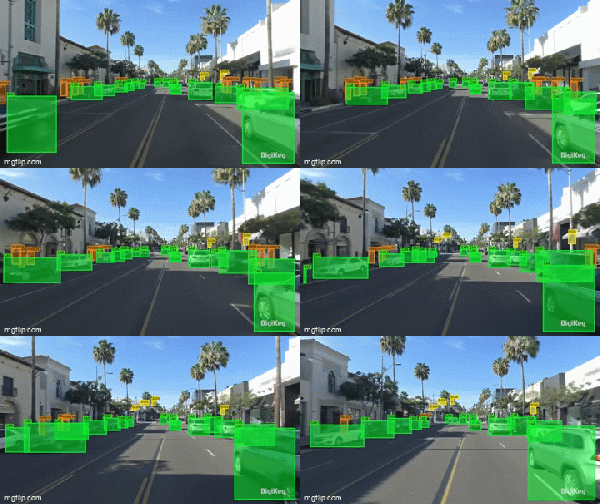
Indeed the issue of speed remains, which is why some vehicle makers say they're going to continue their study of copper-based 1394. With the 1394b physical layer, they say, they may ultimately reach bandwidths beyond 400 Mbits/sec. Such speeds would be critical for vehicle multimedia's next stage of development, which calls for real-time, rear-view and side-view cameras that could help prevent accidents. Beyond that, experts foresee a day when front-mounted cameras could be used in such applications as adaptive cruise control, autonomous lane-keeping and collision avoidance. All such systems would be likely to use video networks.
"At this point, the network is still for communication," says Wong of Nissan. "But in the future there's going to be a need to connect 1394 networks to real-time cameras for (safety) applications."
Industry observers add that such safety measures may one day be mandated in trucks and semi-trailers, making high-speed networks a necessity. "The trucking industry might eventually be forced by regulations to implement lane-maintenance systems," notes Max Bassler of Interactive Technology, a consultant to industry on global standards in the electronics' business. "This is not just a technology for passenger cars."
For such reasons, observers believe that acceptance of copper is inevitable with time. Copper technology, they point out, has weathered skepticism before.
"Copper is being used in aerospace, satellites, and in diagnostic buses for radar, where users can't risk having any EMI," Teener says. "If it can be used in those applications, it can work in automotive."
| Useful Links | ||
| Check out the links below for more info | ||
|
More on automotive data buses:
http://rbi.ims.ca/4924-567 |
IEEE 1394 Trade Association:
http://rbi.ims.ca/4924-568 |
MOST Cooperation:
http://rbi.ims.ca/4924-569 |
Talkback
DN's Resource Center Get Free Information, Made Easy
-
Web Event: October 15, 2008, 10AM Pacific, 1PM Eastern CAD/CAE Model Clean-Up: Reduce Design, Analyze, and Revise Cycles
Anark | Web Event
Request Item -
Catalysts for Innovation
Hewlett Packard | Design Guide
Request Item