Medical World Poised for Internet Era
The Internet-enabled heart ushers in a new method of cardiac care.
Charles J. Murray, Senior Technical Editor -- Design News, January 8, 2007
Imagine being roused by a midnight phone call from your doctor: “I’m sorry to wake you,” he says, “but you’re having another episode of irregular heartbeat.”
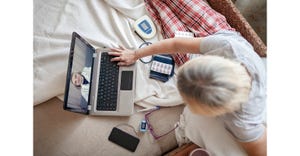
As hard as that is to envision, it’s already happening. New cardiac devices come complete with RF transceivers that enable them to communicate with devices outside your body, even while you’re sleeping. Wireless implantable defibrillators, for example, are able to wake themselves and send RF-based data to a nearby monitor, across an analog phone line, and, finally, to an Internet server that can alert a physician.
Such wireless capabilities are changing medicine. Medical electronics manufacturers say that patients, physicians and health care providers are realizing the benefits of an Internet-enabled heart.
“If you’re a patient on your annual pilgrimage to Florida, and your device has just gone off, you can transmit your data back to your doctor in Chicago,” says Mike Hess, vice president of product planning for Medtronic Inc. “Imagine the advantages to having your home physician look at the data from your device, as opposed to showing up in an emergency room.”
Indeed, reduction of emergency room visits is a boon to health care providers, which would otherwise pay the high expense of such visits. Moreover, physicians say they can help more patients by employing such remote access devices, because they eliminate many of the office visits that would otherwise clog their clinics. Medical electronics manufacturers say it helps patients who come to the office, as well.
“Now we can wake up the device and interrogate it while patients are in the clinic’s waiting room,” Hess says. “By the time they reach the examination room, the doctor has all their data.”
Shockless Therapy
Such happy conveniences weren’t always the case, however, especially in the world of implantable defibrillators. Twenty years ago, patients lived in fear of the next 800V electrical wallop delivered by their defibrillators. The devices, designed to slow a runaway heartbeat by shocking the heart out of its tachyarrhythmia, originally offered a single solution: the big bang. That solution often knocked users to their knees and instilled an extraordinary fear of the next therapy episode. Some patients banded together in support groups to discuss their fears of the shock, which carried a voltage six times that of normal household electrical current. A few actually asked their cardiologists to remove the devices, preferring the risk of sudden cardiac death to the blue bolts of therapy.
Fortunately, though, technology came to the rescue during the past 20 years. Faster capacitors, better microprocessors, and smarter software laid the foundation for a new breed of implantable defibrillators. Today’s units use almost imperceptible “pacing” energies – sometimes as low as 8V – to persuade the fast-beating heart to return to its regular rhythm before resorting to more powerful measures. The ability to do so has been largely due to experience and to the application of those capacitors, microprocessors and, in particular, smarter software algorithms.
“We’ve taken the algorithms and applied them to rhythms as fast as 230 beats per minute, and found out that three out of four times we could get them out of that rhythm without the shock,” Hess says.
Medtronic’s latest implantable defibrillator, known as the Virtuoso, does all this while simultaneously gathering 4V-current from its battery, multiplying it in the capacitor, and preparing to deliver the big, 800V charge. That way, the unit is prepared in the event that the smaller pacing energies aren’t successful. If the smaller currents stop the tachyarrhythmia, however, the big shocks aren’t needed.
Improved electronic memories then enable such episodes to be recorded. And that, of course, sets the stage for Internet use. Medtronic accomplishes that with a bedside device called the CareLink Monitor, which receives information from the Virtuoso at prescheduled dates and times via a 402-MHz radio frequency link, and then transmits that data without the patient needing to do anything. Similarly, St. Jude Medical offers a table-top device called Housecall Plus, which even provides live medical professionals to analyze data immediately and communicate with patients.
In the near future, medical manufacturers plan to take the technology further, adding the ability to monitor fluid build-up in the thoracic cavity, as well as recording pressure inside the heart. Using a technology known as OptiVol Fluid Status Monitoring, for example, devices can measure the level of resistance to electrical pulses traveling across the thoracic cavity. By inferring changes in electrical impedance, the system “knows” if fluid is building up, and therefore can provide early warnings of possible heart failure. Similarly, Medtronic’s Chronicle investigational defibrillator will record pressure inside the heart itself, providing an additional early warning of possible heart failure.
Engineers predict that capabilities such as those will be enhanced, too, through the development of better sensors, batteries and software. They say they’re looking for biochemical sensors that are more able to withstand the harsh environment inside the human body and they’re developing battery chemistries that will enable pacemakers and defibrillators to remain inside the body longer than the five to 10 year span that’s now the norm. Smarter microprocessors could help, too, by drawing less current when they’re not needed. Finally, doctors are calling for greater software compatibility, which would enable them to incorporate device data more easily into their medical records, so they could make more informed decisions.
Physicians say that such abilities will take medical device developers out of the realm of pure pacemaking and rhythm management, and into a larger world of disease management and prevention. In essence, such technologies enable the medical community to provide early indications of heart deterioration, rather than waiting for worsening symptoms.
“It’s the wave of the future,” Hess says. “Physicians will track patients in their homes, gather real heart pressure data, and make medical changes over the phone, instead of having them come to the clinic several times per week for multiple physical examinations.”