Skip navigation
ADVERTISEMENT
You will be redirected to your destination in 16 seconds.
Electronics Industry Search
Advertisement
RSS
Reprints/License
Print
Email

Metal Injection Molding Shines for Medical Parts

Novare Surgical turned to metal injection molding, a fast-growing process that combines the best of plastics and metals

Doug Smock, Contributing Editor -- Design News, June 22, 2008

Dave Danitz invented a new type of fully mechanical laparoscopic surgical instrument that requires tight tolerances on a metal jaw at the distal end that cuts tissue or holds critical tools.

He turned to an emerging process technology in which a wide variety of metals can be injection-molded to tight tolerances. “We started out looking at investment casting for the jaws,” says Danitz, vice president of research and development at Novare Surgical Systems, Cupertino, CA. “There were a few features where we require pretty high tolerances, so investment casting wasn’t looking like the best choice.”

In the metal injection-molding process, fine amounts of metal are mixed with a plastic binder that allows the material to go through a standard injection-molding machine and fill mold cavities, much the same as 100 percent plastic compounds. The plastic is then removed from the green part through a debinding operation and then the part is sintered to a final shape, which can be about 60 percent smaller than the as-molded part.

“The shrinkage is very predictable,” says Tony Pelke, an engineer at Phillips Plastics, which molds the surgical jaws for Novare Surgical. “It’s critical that the process begin with a very consistent feedstock.”

The tightest tolerance in the jaws used in Novare’s RealHand system (see sidebar below) is in its back end. “We have a slot in there that is oriented at an angle,” says Danitz, “so that when you pull a pin through, it actuates the jaw. So we want to minimize the force required to actuate the jaws. We want to maximize the mechanical advantage of the jaw. That slot is right on the verge of where you can slide a pin and if you go a little bit too shallow, it actually binds. It’s an angular tolerance of half a degree, which converts to a Cartesian tolerance of plus or minus a thou (25.4 microns).”

Phillips Plastics uses secondary calibration equipment in which each jaw is located under a vision system. A servo-driven motor calibrates the jaw from side to side to make sure it’s in the proper location. “And during final assembly, no matter how you pick up the jaws in any combination of tops and bottoms, they will line up perfectly,” says Pelke. “The biggest issue with medical jaws is that they have to line up at the tips and the teeth have to mesh up.”

The Novare Jaws application is a good example of why the metal-molding process is growing at an annual rate of 10 to 12 percent even though overall U.S. manufacturing is growing at just 2 percent a year.

High-Volume Process

“Metal injection molding is a high-volume technology that can produce details as fine as 0.25 mm on a regular basis and also create geometries that are unattainable by conventional processes such as stamping, screw machining, even standard powder metallurgy,” says Matt Bulger, president of the Metal Injection Molding Assn. and general manager of NetShape Technologies in Sellersburg, IN. “And you get materials that are close in mechanical and physical properties to the mill equivalents.”

In other words, you get the properties of metals in shapes previously only attainable in plastics.

Most metal injection-molded applications are parts that have been converted from other processes. Experts say if design engineers considered metal molding at the very beginning of product development, many more designs could benefit from the process.

“If metal injection molding is considered at the early design phase, fairly small changes could have large financial or production yield implications,” says Randall M. German, a professor of mechanical engineering at Mississippi State University and a longtime expert in metal molding. “The big victories have come in designs where functions have been combined, not only in similar materials, but in dissimilar materials.”

There are automotive applications, for example, where one portion of a component is magnetic and another is nonmagnetic. “That’s useful if you have a gear that’s turning and at the same time you want to have a sensor to measure the velocity,” says German.

The jaws for the Novare Surgical instrument were designed slightly differently for the metal-molding process. “We went through every dimension on the component with Novare at a design review,” says Pelke. “We really tried to optimize the design for the process. For example, we designed in flat features to allow for proper sintering configurations. The part needs to be properly supported to avoid potential downstream problems.”

Metal injection molding is best suited to designs for small, somewhat complex parts, with production requirements of at least 5,000 pieces. “If the part is too simple, it would be too expensive in metal injection molding (because of the tooling costs),” says German. “If you go to very complex parts, the tolerance stack-up can become a killer. I saw one automotive part that had 130 dimensional call-outs and that proved a little too much for the technology. There’s a window for complexity and number of specifications where the technology really thrives.”

Bulger estimates metal injection molding typically delivers savings of 40 to 50 percent for the right geometries.

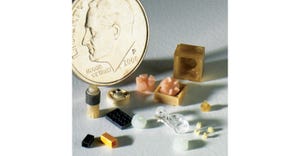
The jaws in the RealHand are metal injection molded.
Click below for more images:          1         2         3         4        
Advertisement

Sponsored Content

Technology Marketplace

Gallery »

Metal Injection Molding Shines for Medical Parts

Novare Surgical turned to metal injection molding, a fast-growing process that combines the best of plastics and metals

RSS
Reprints/License
Print
Email
Find a supplier on oemsuppliersearch.com

Talkback
Advertisement
Reed Business Information Resource Center

Featured Company


Advertisement

Design News Partner Zones

Light Matters: The Unsung Heroes of Modern Health Care
First, let's define "no-compromise." In an ideal configuration, this lamp would use a high-brightness LED (HBLED) that is built into a small, integrated package and is able to produce a large quantity of focused light, operate with a high level of reliability and generate no audible noise. Is this difficult? Yes, but it is possible.
Read More


Design Engineers' Portal for Sensing and Machine Safety
Whatever industry you're in, or whatever product you manufacture, the right sensors to automate your plant, and to improve your overall efficiency, quality and safety are a must. You'll find Banner Engineering to be an amazing resource of products, training and people with expertise.


Test & Measurement World Machine Vision & Inspection Report
Topics include machine-vision software, Power over Camera Link, thermal imaging and frame grabbers. Read More

Design News Partner Zone Directory »

Please visit these other Reed Business sites