Log In   |  Register Free Newsletter Subscription
Skip navigation
Zibb
Subscribe to Design News
RSS
Reprints/License
Print
Email

An Update on Shielding

Jon Titus, Contributing Editor -- Design News, November 1, 2009

When you measure a sensor's signal, you don't want ambient electromagnetic noise added to it. So you rely on shielded twisted-pair wires to protect the sensor's signal. The shield provides a path to ground for ambient electrical noise. (A shield also reflects some of the ambient noise and in some cases lets noise through to the signal wires.)

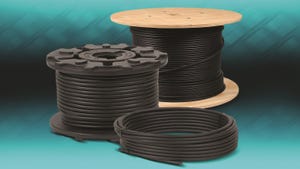
The quality of the shield greatly affects how much noise gets to your signal wires. The photo below shows examples of shielded wires. The twisted-pair cable, A, has a 100 percent aluminum-foil shield and separate "drain" wires that connect to the shield and simplify a ground connection. These separate wires have a lower resistance than the foil alone. The inexpensive RG-58/U coaxial patch cable, B, has a foil shield and about 20 small-gauge shield wires. The RG-58C/U coaxial cable, C, provides a stranded center conductor and a woven copper shield. The shield still has small openings that very-high-frequency signals could penetrate. High-quality coax cable can provide up to about 95 percent woven-shield coverage. (Go with a 100 percent shield if you can.)

Now that you have a shielded cable, where do you ground it? I have recommended grounding it at the measurement end. Grounding at both ends can cause ground loops that compound problems and can add powerline noise to sensor signals. In some cases, you can ground one shield end and run the other shield end to ground through a small-value capacitor.

But recently I read this rule of thumb: When a length of cable shield exceeds 1/20th of the wavelength of the highest-frequency noise signal, you should ground both ends of the shield. But what's the source of the 1/20th rule? David Ballo, an application development engineer in the Component Test Div. at Agilent Technologies uncovered a reference I paraphrase below. (See References below.)

The key assumption in single-point grounding is that the wavelength of the highest noise frequency is long relative to the physical dimensions involved, so you assume everything electrical occurs simultaneously and uses lumped-circuit analysis. But when wavelengths are short enough that the physical dimensions become significant, you need to use distributed circuit analysis. Then, a single-point grounded shield starts to look like an antenna. You have an optimum "antenna" when the shield length equals one-quarter wavelength of the noise signal. Then you must ground both ends. The author's rule of thumb is that you need multipoint grounding when the shield length exceeds 1/20th wavelength of the highest frequency of interest.

I'll have more to report on the 1/20th rule of thumb and shielding in my next Tips column. In the meantime, I welcome comments that practically or theoretically explain the 1/20th wavelength figure at jontitus@comcast.net.

An Update on Shielding


Author Information
Jon Titus, a former designer and chief editor of EDN and Test & Measurement World magazines, remembers when "fast" signals operated at 10 MHz and programs came on paper tape.
RSS
Reprints/License
Print
Email
Talkback
Reed Business Information Resource Center

Featured Company


Most Recent Resources

Advertisement

Sponsored Content

Technology Marketplace

More Content
  • Blogs

Design News Staff

From the Newswire

Design News Staff
December 16, 2009
Machined Spring Features HELI-CAL Flexure
MOTION CONTROL:  The HELI-CAL® Flexure is a flexible helix (curved beam)...
More

Design News Staff

From the Newswire

Design News Staff
December 16, 2009
CUI's New Medical Supply Offers 365W Output Power in a 3 x 5 inch Footprint
ELECTRONICS:  CUI Inc’s power division, V-Infinity, announces an...
More

Design News Staff

From the Newswire

Design News Staff
December 16, 2009
Linear Technology's Triple Output LED Driver Drives up to 30 x 300 mA LEDs & Offers 3000:1 True Color PWM Dimming
ELECTRONICS:  Linear Technology Corp.’s LT3492, a 2.1MHz dc/dc...
More

VIEW ALL BLOGS RSS

MechatronicsZone Promo
Advertisement
Texas Instruments Video Exclusives
eNewsletters
Gadget Freak
Sherlock Ohms
Made by Monkeys
Design Tools
Electronics/Test
Sensors/LED
Mechatronics
Motion Control & Fluid Power
Materials & Fastening
Special Technology Reports
International Engineering


Please read our Privacy Policy

About Design News   |   Advertise with Design News   |   Site Map   |   Contact Us   |   Subscription   |   Affiliate Links   |   RSS
© 2010 Reed Business Information , a division of Reed Elsevier Inc. All rights reserved.
Use of this Web site is subject to its Terms of Use |  Privacy Policy
Please visit these other Reed Business sites