What's Next after the Dreamliner? Think Fuel Cells
Lightweight, heat-resistant membrane fuel cells show potential to provide power for commercial aircraft
Doug Smock, contributing editor -- Design News, September 18, 2009
The Boeing Dreamliner is a huge leap in aircraft design. Not surprisingly, the carbon-composite-sheathed 787 is running into the type of severe turbulence that accompanies any major technology change.What will be the next revolution in aircraft design? How about hydrogen power?
"By using liquid-hydrogen, there is the potential to create aircraft that are capable of the same missions as current aircraft, but use less energy, use less natural resources, have smaller environmental impact, and are as safe as or safer than current aircraft," says David C. Maniaci, who researched the issue for the Dept. of Aerospace Engineering at Penn State University.
Boeing engineers have stated that hydrogen, if produced via nuclear or solar power, could be a long-term factor as an aviation fuel, and Boeing in fact tested a small, manned plane two years ago.
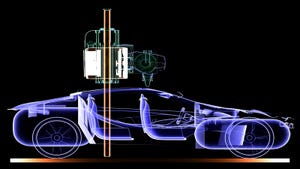
Assuming production of hydrogen from an environmentally suitable source is a huge given, as previously reported by Design News. Significant design problems also lie in the way. Hydrogen has a high energy density per unit mass, but a low energy density per unit volume compared to currently used jet fuels. Containing hydrogen would require a high-pressure container. It's likely fuel would have to be stored in the fuselage, not wings, creating further obstacles.
Heat-Resistant PolymerNew work, however, on air-cooled, hydrogen fuel cell membranes using the heat-resistant polymer polybenzimidazole are showing promise. In fact, the membranes may be used in future Airbus A320s to produce electricity for onboard use.
The technology is being demonstrated in Germany where Antares DLR-H2, the world's first piloted aircraft capable of taking off using only power from fuel cells, made a test flight at the Hamburg airport. The plane has been developed by the German Aerospace Center (Deutsches Zentrum für Luft- und Raumfahrt; DLR).
Technically, it's a motorized glider. It has zero carbon dioxide emissions and makes less noise than comparable aircraft.
The Antares DLR-H2 is powered directly by an ultra-efficient fuel cell using membrane technology developed by BASF. "We have improved the performance capabilities and efficiency of the fuel cell to such an extent that a piloted aircraft is now able to take off using it," says Johann-Dietrich Wörner, chairman of DLR. "This enables us to demonstrate the true potential of this technology, also and perhaps specifically for applications in the aerospace sector."
Hydrogen is converted into electrical energy in a direct, electrochemical reaction with oxygen in the ambient air, with no combustion. The only by-product is water. In the membrane electrode assembly, or MEA, chemical energy generated by the reaction between oxygen and hydrogen is converted directly into electricity and heat.
"BASF is participating in the pilot project to promote an innovative energy technology which will really be taking off in the near future, and not just on board aircraft," says Carsten Henschel, a technical expert at BASF Fuel Cells. "In times of scarce energy resources the fuel cell can, for example, help maintain security of supply because hydrogen can be obtained from a wide variety of sources: from wind or solar energy and from natural gas or diesel."
Design ChallengesThe design challenge is to keep the fuel cell system as light as possible. Conventional low-temperature fuel cell systems operate at a maximum of 80C, and require a large number of ancillary units, as well as a complex control system.
The MEA in the Antares glider uses the world's first commercially available membrane for fuel cells that withstand operating temperatures of up to 180C. These fuel cells are air-cooled and don't require humidifiers, water pumps, tanks, valves and cleaning systems.
The heart of the technology is polybenzimidazole, the same heat-resistant plastic used for firefighters' suits. A high operating temperature also prevents impurities in hydrogen from building up on a platinum-coated electrode (anode). Platinum is the catalyst that starts the electrochemical reaction in the MEA.
The BASF fuel cell systems, called Celtec, use a third fewer components than conventional duel cell systems. "This reduces the costs by up to 40 percent. The development of the high-temperature membrane has finally made the fuel cell interesting as a commercial sales product," explains Henschel.
The fuel cell system that powers the Antares delivers up to 25 kW of electrical power, operating at an efficiency level of approximately 52 percent when flying in a straight line, using only 10 kW of power.
A single cell can only deliver a voltage of about 600-700 millivolts, so several cells are combined into a fuel cell stack to produce enough power. Each of the MEAs is in a matrix of electrically conductive graphite plates that connect the individual cells together. The plates conduct the electricity and supply the MEAs with hydrogen and oxygen through special ducts.
Airbus A320 tests"Following the test flights in the Antares, we intend to install the fuel cell in our Airbus A320, where it will be optimized for use in wide-bodied aircraft to make the onboard electricity supply more efficient in future," says Josef Kallo of the DLR in Stuttgart. The byproducts heat and water could also serve as "antifreeze" for the wings and to supply the washrooms. The DLR worked with Airbus Germany to implement a fuel cell system as the auxiliary power supply for the hydraulic pumps of the steering system of the DLR's research aircraft Airbus A320 ATRA.
The DLR test series with the Antares are scheduled for completion in 2010 and the fuel cell will then be used in DLR's "A320 ATRA."
The Antares DLR-H2 is based on the Antares 20E self-launching motor glider, produced by Lange Aviation GmbH.
Unlike some other aircraft research projects, this one is far from science fiction. BASF has a fuel cell production facility in Frankfurt and is cranking up a new plant in Somerset, NJ.
-
PEM Fuel-cells working in a range of 5 to 65 Celsius, uses palladium and this mean it not give enough for all airplane ... Have a to high cost because hydrogen is generating using other energy fonts. This means that it is necessary an other conversion of energy, at end it isn't a clean energy!!'>Sorry, but You talking about Hydrogen but you don't working in this area.
PEM Fuel-cells working in a range of 5 to 65 Celsius, uses palladium and this mean it not give enough for all airplane ... Have a to high cost because hydrogen is generating using other energy fonts. This means that it is necessary an other conversion of energy, at end it isn't a clean energy!!
ZV - 2009-30-9 16:34:58 EDT