Skip navigation
Electronics Industry Search
Advertisement
Email
Print
Reprints/License
RSS

Tomorrow's Fuel-Efficient Automotive Transmissions

Automotive engineers are revamping the transmissions of conventional vehicles to save fuel without sacrificing driving performance

Joseph Ogando, Senior Editor -- Design News, June 22, 2008

A big shift is looming in the type of automotive transmissions we drive. Under pressure to improve the gas mileage of their vehicles, automakers all over the world have taken an interest in fuel-efficient transmission styles such as dual clutch, continuously variable and planetary automatics with six or more speeds.

The CTI Symposium on Automotive Transmissions, which started just outside Detroit yesterday, highlighted the growing role these advanced transmission technologies will play in the coming years.

Robert Lee, Chrysler’s vice president of powertrain engineering, kicked off the event with an overview of the pressures facing the automotive industry today. “There’s a perfect storm brewing,” he said. It’s a storm brought on by the reaction of consumers and government regulators to rising fuel prices and uncertainty about the future supply of fossil fuels.

A portion of the car-buying public may try to ride out that storm in hybrid electric vehicles, which now get most of the popular attention in the debate about how to minimize our fuel consumption. CTI even devoted a day of the symposium to hybrid technologies.

Lee's speech, however, served as a reminder that engineers can still improve the conventional vehicles too by scouring them for fuel-wasting losses. “Solving the fuel economy puzzle requires a total-vehicle solution,” Lee said, emphasizing the interrelatedness of the various vehicle subsystems. But he also argued advanced transmissions represent a particularly important piece of that puzzle.

In Chrysler’s case, alternatives to the traditional four-speed automatic transmission have started to make a significant contribution to fuel economy. Mircea Gradu, Chrysler’s director of transmission and driveline engineering and a Ph.D. mechanical engineer, reported the use of continuously variable transmission (CVT) in some of the company’s SUVs provides a 6- to 8-percent improvement in fuel economy — and an 8 percent gain in 0 to 60 mph time. And he estimates upcoming dual-clutch transmissions (DCT) will improve fuel economy by 6 to 8 percent. “We’re very excited about working on DCT,” he said.

Those fuel economy figures are based on early measurements and estimates, but Gradu thinks they might get better over the long haul. He outlined ways to further improve the efficiency of both CVTs and DCTs. The latter transmission type, for example, could benefit from a seventh speed for a larger ratio spread, reduction in cooling-related parasitic losses from the wet dual-clutch module, clutch materials with higher energy capacity and better actuation methods. “DCTs have a slightly higher fuel economy potential than CVTs. Whether it’s one, two or three percent depends on the platform,” he said.

Chrysler isn’t alone in its interest in more advanced transmissions. General Motors presented information on its newest family of six-speed transaxles for the global market. Jeffrey Lux, chief engineer for transmission engineering at GM Powertrain, talked about the full range of design and performance goals for the new transmission — a range that included a compact package, mass efficiency, NVH performance and drivability. He put the fuel economy gain at 4 percent compared to current four-speed automatics, a savings brought about in large part by the optimized gear ratios made possible by a greater number of speeds.

Under some driving conditions, the fuel economy gain could be even more than 4 percent. Lux said putting a six-speed transmission in the recent Chevy Malibu produced a 2-percent increase in highway mileage, which translates to something more like a 7-percent improvement over a four-speed.

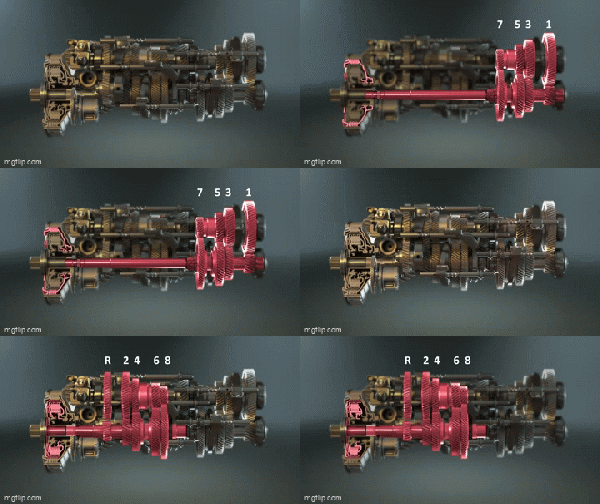
The symposium did feature other examples of automatic transmissions with six or more speeds — including a new eight-speed planetary design from ZF GmbH and a nine-speed from India’s Tata Motors.

“The entire market is shifting to six-speed and six-speed-plus automatics,” said John Maten, engineering group manager at GM Powertrain. He went on to present the results of a complex global study that compares the fuel efficiency of different transmission types — complex because the study had to harmonize the very different driving styles, consumer preferences and predominant transmission technologies found in different regions.

He and his colleagues ended up selecting an Opel Astra with a 1.8-liter gas engine as the baseline car. It’s normally available with either a five-speed manual or four-speed automatic transmission, but the study evaluated it with other transmission variants — a five-speed manual with automatic clutch actuation (MTA), six- and seven-speed wet DCTs, six- and seven-speed dry DCTs, a CVT and a six-speed planetary automatic. The results, based on measured data from currently available transmissions, have the MTA offering a 2.5- to 5-percent fuel economy advantage over the baseline manual transmission. The dry DCT offered a 2- to 5-percent gain while the wet DCT spanned a range from -1 to 2 percent of the baseline fuel economy.

The good performance of the DCT bodes well for it in the future. “DCT has now supplanted CVT as the leading edge technology,” said Scott Tackett, senior technical research analyst for Global Insight. And he forecasts the DCT will grow from next to nothing now to 4 million units globally by 2018. “DCT will have the highest percentage growth rate of any transmission type. It will be the big mover,” he said.

Advertisement

Sponsored Content

Technology Marketplace

Email
Print
Reprints/License
RSS
Find a supplier on oemsuppliersearch.com

Advertisement
Reed Business Information Resource Center

Featured Company


Advertisement

Design News Partner Zones

Light Matters: The Unsung Heroes of Modern Health Care
First, let's define "no-compromise." In an ideal configuration, this lamp would use a high-brightness LED (HBLED) that is built into a small, integrated package and is able to produce a large quantity of focused light, operate with a high level of reliability and generate no audible noise. Is this difficult? Yes, but it is possible.
Read More


Design Engineers' Portal for Sensing and Machine Safety
Whatever industry you're in, or whatever product you manufacture, the right sensors to automate your plant, and to improve your overall efficiency, quality and safety are a must. You'll find Banner Engineering to be an amazing resource of products, training and people with expertise.


Test & Measurement World Machine Vision & Inspection Report
Topics include machine-vision software, Power over Camera Link, thermal imaging and frame grabbers. Read More

Design News Partner Zone Directory »

Please visit these other Reed Business sites