Skip navigation
Electronics Industry Search
Advertisement
Email
Print
Reprints/License
RSS

Future Combat Systems Changes the Face of Battle

The U.S. military’s Future Combat Systems links soldiers and robots in a vast wireless network

Charles J. Murray -- Design News, January 6, 2008

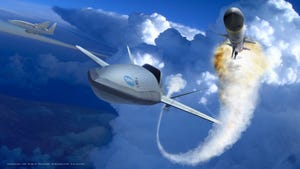
The scenario is straight out of a science fiction movie: A flying saucer-like vehicle hovers outside a building’s second story window, using sensors and thermal imaging to search for life or weapons inside. The vehicle’s optical sensors find an explosive device, transmit data about it to a military commander, who decides to take out the building.

Too far-fetched? Hardly. Together with 25 prime contractors and 600 more sub-primes, the U.S. military is already working on a system that will do that and much more. Known as Future Combat Systems (FCS), it’s considered the most ambitious technical program in U.S. military history.

“This is a huge engineering development challenge, which is why we’ve engaged industry to help us,” says Paul Mehney, public communications officer for the program manager for FCS. “It’s a revolutionary way for the U.S. military to do design and development.”

Indeed, U.S. joint forces are teaming with industry, largely because of the enormity of the project. FCS involves nine different types of manned ground vehicles, ranging from mounted cannons to surveillance systems. It includes two classes of robotic aerial vehicles, from the saucer-like hovering vehicle to an unmanned mini-helicopter. It also includes two classes of unmanned ground vehicles, four kinds of tactical sensors, three types of urban sensors, centralized controllers for soldiers and an all-encompassing network built on approximately 67 million lines of software code.

“The idea is to create systems that act in concert to form a network, enabling our soldiers to see and understand what’s going on and make faster decisions about what to do,” explains Ted Goetz, director of software and distributed systems for Boeing Integrated Defense Systems, a major systems integrator for FCS.

Doing that, however, will be no easy task. The military is targeting 2015 as the date for full deployment, adding fuel to the raging fire of development that’s taking place in companies across the country.

“If you look at the Abrams (tanks) or Bradley (fighting vehicle), those systems were in development for 15 to 20 years,” Mehney says. “Here, we’re developing 14 hardware platforms plus a network from the ground, up, in 15 years.”

Robotic Emphasis

FCS’s defining elements are its dedication to robotics and its penchant for linking those robotic systems to the soldier via a vast wireless network. To be sure, the program also has nine manned ground vehicles, including infantry carriers, medical vehicles, mounted combat systems and mounted cannons, as well recovery and maintenance vehicles. But its key characteristic — the element that puts the “future” in Future Combat Systems — is FCS’s use of robotic vehicles.

Prime among those are its Class 1 Unmanned Aerial Vehicle (UAV) and the Small Unmanned Ground Vehicle (SUGV). The reason for the emphasis on robotics in these vehicles is a sound one: to keep the soldier, as much as possible, out of harm’s way. U.S. Army security reports repeatedly emphasize the safety issue, particularly when explaining the program’s $21 billion price tag. “The cost of modernization is measured in dollars,” the Army writes in a Torchbearer National Security Report. “The cost of failing to modernize is measured in lives.”

The unmanned UAVs help in that regard because they serve as a sensor platform, able to perform surveillance and reconnaissance in locales where brigades would rather not send soldiers. In particular, the Army hopes it will keep troops safer by identifying improvised explosive devices (IEDs) from the sky.

“The Army will use it as ‘small eyes and ears,’” says Mehney. “It can track enemy movement and provide better situational awareness in the battle space. And the benefit is that whatever it sees will be transferred over the FCS network.”

Based on the so-called Micro Air Vehicle developed by Honeywell Inc., the UAV is a ducted-fan vertical takeoff and landing vehicle powered by a heavy fuel engine. About the size of a small office trash can, the 41-lb UAV can be carried into battle by troops and can be launched vertically, like a helicopter, from complex desert and urban terrains. Although it uses autonomous flight and navigation algorithms, it also interacts with soldiers and with the network to dynamically update routes and target information.

The key to the Class 1 UAV, however, is its sensor platform, which includes electro-optical and infrared (IR) devices. The sensors gather information, which can then be transmitted across FCS’s wireless network to soldiers.

“Let’s say the UAV sees a bad guy placing an IED,” Mehney says. “A squad sergeant can see that, and if he’s comfortable taking him out, he can do that because he has the situational awareness.”

Moreover, IR sensing technology enables the UAV to see at night. “It can look inside a building, which an optical sensor can’t do,” Mehney says. “It can sense heat in or around structures where you may not have an optical line of sight.”

Owning the Night

Similarly, FCS engineers are working hard on robotic ground vehicles. The military, for example, is teaming with iRobot Corp., the company that created the famed Roomba vacuuming robot, on the development of the so-called SUGV.

The SUGV helps soldiers in numerous ways. FCS brigades plan to use it for detection of bombs beneath vehicles and for searching inside buildings.

“If there’s someone in a building and you want to know what he’s doing, you can send the SUGV in for a look,” Mehney says. “It makes a lot more sense to send a robot in than to send a soldier in.”

The unit, an evolution of the so-called PackBots already used in Iraq, weighs about 30 lb and is “man-packable.” It incorporates a suite of sensors, including a wide-angle optical sensor for driving, a low-light zoom camera for up-close views and a thermal imaging camera for seeing in the dark. Soldiers see images from the camera in real time on a goggle-mounted display and operate the robot using a game-style controller.

“We use the game-style controller so that the soldiers, who have grown up with video games, have familiarity with it,” says Bob Bell, executive director of FCS programs for iRobot.

The SUGV is powered by dc motors, which draw current from military-type BB 2590 rechargeable lithium-ion batteries. Using motors to drive the robot’s tracks and more to move its head and neck, the SUGV can travel over rough terrain and provide close-up views of devices that no soldier wants to examine.

“It can go up and down stairs and over rubble,” Bell says. “And it can go into caves, tunnels and sewers to look for threats.”

And when it arrives at its destination, the SUGV can use speakers and microphones to interrogate people from a distance of 200 yards or more. It can crane its neck to see over obstacles, can lower its head to look under cars and can lean back and stand up in a reconnaissance mode. Even in darkness, it can spot explosive devices and trip wires.

“It can see in total darkness,” Bell says. “It can see people behind bushes. It’s how the U.S. Army owns the night.”

Sensor Platforms

The Army also plans to own the remainder of the day by employing a suite of tactical and urban sensors. All sensors in the suite are designed to weigh less than 25 lb and all have two-day endurance power.

Tactical Unattended Ground Sensors (T-UGS) have magnetic, acoustic and seismic sensing capabilities and are positioned around the battle space to provide near-real-time feedback of enemy and soldier movement. Developed by Textron Defense Systems, they include sensor nodes, capable of detecting soldiers across open ground, vehicles and aircraft. They also include gateway nodes, which transmit information, as well as electro-optic nodes and radiological nuclear nodes.

Urban Unattended Ground Sensors (U-UGS), designed by Textron in collaboration with Honeywell, are designed for a slightly different set of tasks. “The urban sensors are a little smaller, they’re hand-placed and they work in smaller environments,” Mehney says. Typically, the U-UGS are placed inside buildings, as well as caves, sewers, tunnels, alleys and other confined spaces. They include gateway nodes for communications, intrusion sensor nodes and imaging sensor nodes.

“Soldiers will be able to leave one or two of these in a building and with that video imagery, they’ll know if people are coming in or out,” Mehney says. “The advantage is, they don’t have to leave a soldier behind to know that.”

The Big Picture

Tying all of that information together in a network and developing a system to process it, however, may be the biggest task of all.

During FCS operation, the network has to grab all the information from sensors, as well as all the voice communications from radios and integrate it into a common operating picture, so the war fighter can understand every situation.

“The challenge is, how do you create such a software suite and still stay within cost?” asks Goetz of Boeing, which is serving as FCS system integrator, along with Science Applications International Corp. (SAIC). “And how do you do it on schedule and do it so it will fit in a reasonably sized computer, so you don’t have use a Cray computer to run your unmanned vehicle?”

Boeing engineers say the answer to those questions lies in the network software. The core of that massive software system is the Battle Command Software, which consists of a variety of applications that enable soldiers to see what’s going on, based on input from sensors. The Battle Command Software serves as an interface for the soldiers and commanders and includes code for mission planning and preparation, situation understanding and mission execution, as well as war fighter-machine interface. It, in turn, lies atop a custom-designed middleware called the System-Of-Systems Common Operating Environment (SOSCOE). SOSCOE, which enables integration of separate software packages, combines commercial off-the-shelf hardware with an Army-compliant operating environment to act as the foundation of the network.

“It provides the communication services, security, data services and knowledge-support services,” Goetz says. “Basically, it creates a standard set of services that allow other applications to plug and play.”

Engineers and Army spokesmen say that task is almost unimaginably enormous. Contractors — including the likes of General Dynamics, IBM, Northrop Grumman and Raytheon, as well as Boeing, Honeywell, Textron and a score of other primes, along with approximately 600 more sub-contractors, are supplying everything from engines to embedded operating systems. The number of engineers involved in the project has grown so large that spokespeople for the U.S. Army and its prime contactors could not estimate the figure, saying only that it has now reached the “multiple thousands.”

“It’s a gigantic project and it takes a lot to bring it all together,” Goetz says.

“It takes the best that industry can bring to bear,” adds Mehney. “The military has not done procurement, acquisition, research, development and design in this fashion, ever.”

Advertisement

Sponsored Content

Technology Marketplace

Gallery »

Future Combat Systems Changes the Face of Battle

The U.S. military’s Future Combat Systems links soldiers and robots in a vast wireless network

Email
Print
Reprints/License
RSS
Find a supplier on oemsuppliersearch.com

Advertisement
Reed Business Information Resource Center

Featured Company


Advertisement

Design News Partner Zones

Light Matters: The Unsung Heroes of Modern Health Care
First, let's define "no-compromise." In an ideal configuration, this lamp would use a high-brightness LED (HBLED) that is built into a small, integrated package and is able to produce a large quantity of focused light, operate with a high level of reliability and generate no audible noise. Is this difficult? Yes, but it is possible.
Read More


Design Engineers' Portal for Sensing and Machine Safety
Whatever industry you're in, or whatever product you manufacture, the right sensors to automate your plant, and to improve your overall efficiency, quality and safety are a must. You'll find Banner Engineering to be an amazing resource of products, training and people with expertise.


Test & Measurement World Machine Vision & Inspection Report
Topics include machine-vision software, Power over Camera Link, thermal imaging and frame grabbers. Read More

Design News Partner Zone Directory »

Please visit these other Reed Business sites