ADVERTISEMENT
You will be redirected to your destination in 10 seconds.
Electronics Industry Search

Polling Question

Should the government bail out U.S. automakers?

  • Yes
  • No


View Previous Poll Results
Advertisement
Email
Print
Reprints/License
RSS
Article tools sponsored by

Plastic Breakthroughs Emerge for K 2007

Look for new ideas at K 2007, ranging from metal hybrid structures to engineering biomaterials

Doug Smock, Contributing Editor -- Design News, July 26, 2007

The increasing commoditization of engineering plastics such as polycarbonates will push major plastics producers to strive for specialization and differentiation. The focus will be on higher performing grades that offer some type of quantifiable difference: faster cycling, better environmental attributes, improved strength or better heat stability.

That trend puts the focus squarely on design engineers, who are also looking for solutions that improve performance.

These developments will be center stage at K 2007 — the biggest plastics event in the world — in Düsseldorf, Germany Oct. 24 to 31. The new materials and processing technology on display at the K Fair will attempt to address important trends in product design: 1) lightweighting, 2) miniaturization and 3) a shift toward greater styling as a means of differentiation on the part of OEMs.

One example of the emphasis on differentiation is a new process from Bayer MaterialScience that allows automotive lighting components to be custom colored after they are injection molded. OEMs can produce products “on demand” in a matter of hours, dramatically reducing inventory requirements. In the Aura infusion technology, molded parts are immersed in a proprietary, hot, mostly aqueous mixture where they are colored. The part is then removed from the bath, rinsed and dried. According to Bryan L. May, plant and process manager for Apollo Color Coating, which has licensed the technology, weathering is comparable to colors achieved through compounded resins. “The coloring agent actually penetrates the plastic and makes the color a part of the piece, rather than placing a layer on top of it — the color cannot come off or peel,” says May.

An example of lightweighting is the use of “outsert molding” to create novel mechatronic plastic/metal hybrid structures. Ticona will show several assemblies developed in collaboration with the TB&C Outsert Center in Herborn, Germany, in which plastic parts are molded on to two- or three-dimensional metal plates. “Outsert technology means assembly without assembling. Bending, punching and spouting happen in one single process,” says a spokesperson for TB&C. Base materials used for the process can vary from steel and aluminum to acrylic to natural materials, such as flax. There’s an up-to-65-percent reduction in the number of pieces required as a result of the complex construction, allowing lighter-weight assemblies to be made cost effectively,

On display at the Ticona stand will be outsert-molded parts used in medical devices made by B. Braun of Melsungen, Germany. Plastic components made from polyacetal and PBT-type polyester are injection molded onto a metal plate in one shot. The entire frame of an infusion pump system  (chassis, bolt, flap and pump chassis) are produced in the molding machine. No secondary operations are required.

Singulus Technologies AG, Kail a. Main, Germany, will also show a novel hybrid technology called Decoline, which combines injection molding, metallizing and painting in one production line. Developed with Balda AG of Bad Oeynhausen, Germany, the process is aimed at applications like packaging for personal care products, toys and automobile manufacturing.

Another example of the acceleration of specialization comes from Solvay Advanced Polymers, Alpharetta, GA, which is launching a full line of high temperature, wear-resistant plastics. The new materials are designed for wear-resistant applications requiring long-term use in temperatures between 120 and 265°C and short-term use up to 280°C. The wear-resistant grades are available in polyphthalamide (PPA), polyamide-imide (PAI), polyetheretherketone (PEEK), and polyarylamide.

“What’s truly unique about this new suite of products is that you can achieve impressive performance even absent lubricants,” says Nate Harry, senior global market manager for wear-resistant polymers at Solvay Advanced Polymers. “That can be an enormous advantage for industries such as healthcare and food processing where lubricated contaminants must be avoided at all costs.”

What’s new in bio

Environmental issues will be front and center at K 2007.

The biggest newsmaker may well be DuPont because of its big investment in sustainable materials. DuPont Sorona EP products will contain a minimum of  30% to 37% renewably sourced material (by weight) derived from corn with DuPont Tate & Lyle Susterra renewably sourced propanediol as a key intermediate. A new, and unique, plant in Loudon, TN that produces  Bio-PDO consumes 40 percent less energy and reduces greenhouse gas emissions by 20 percent compared to petroleum-based propanediol, according to DuPont.  Annual production of 100 million pounds of Bio-PDO is expected to save the energy equivalent of over 15 million gallons of gasoline per year, or enough to fuel more than 27,000 cars.

At K 2007, DuPont is expected to disclose the first applications for the new engineering thermoplastic, which has been beta tested for about a year.

BASF will be showing the first samples of its new Ecovio L Foam that consists of biodegradable polyester and polylactic acid. The material is designed for foamed food trays and fast-food boxes as a replacement for polystyrene foam. BASF has nothing in the works for engineering thermoplastics made from sustainable resources, according to a spokesperson.

This topic is also clearly on the backburner at Bayer MaterialScience, one of the other German-based giants of polymer development. Management Board Member Ian Paterson, put the issue into perspective at the company’s recent pre-K 2007 press conference in New York City. “We use six million tons of benzene and derivatives a year,” said Paterson in response to a question from Design News. “No one can supply six million tons of bio feedstocks.”  He said that Bayer’s development will be on cost-effective performance enhancements. Bio materials come up short on both of those issues.

There certainly will be significant emphasis on environmental friendliness at the K, however. Several companies will show new grades of nonhalogenated plastics that comply with new European Union regulations.

One exhibitor to watch closely at K 2007 will be SABIC (Saudi Arabian Basic Industries Corp.) By the time of the K, SABIC’s acquisition of GE Plastics may be complete, propelling the Saudi company into the front ranks of engineering plastics producers. One of the big issues to be determined is investment planned for polycarbonate development. SABIC had earlier announced plans to build a major new PC plant in northeastern Saudi Arabia. It’s not clear now if that plant will proceed using GE Plastics technology. Either way, the global dynamics of the PC business will change. PC is already heavily impacted by overexpansion in China.

GE Plastics, if present in the SABIC booth, will be showing nonhalogenated compounds as well as new systems for compounding high-strength Verton materials, which are highly filled long-fiber plastics made from a variety of polymers. GE Plastics will also be showing advances in lead-replacement with injection-molded tungsten-filled compounds.

Here’s a brief review of other highlights:

  • GLS Corp. of McHenry, IL, has developed an oxygen barrier technology for healthcare packaging and delivery systems. The custom-formulated thermoplastic elastomer (TPE)  is said to  provide high oxygen barrier performance that is up to ten times better than conventional TPEs and equivalent to traditional thermoset butyl rubber.

  • Dow  created a new billion-dollar business by combining its recent Wolff Walsrode acquisition from Bayer MaterialScience with its own water soluble polymer business.

  • DSM Engineering Plastics is showing new high flow resins:  Akulon XP - HV polyamide 6 for packaging applications, Akulon Ultraflow polyamide 6 for injection molding applications, and Stanyl High Flow and Super Flow  polyamide 4/6 for injection molding applications  Akulon Ultraflow possesses 80 per improved flowability compared to standard nylons, yielding  around 25 per cent  cycle time reduction and high-quality surface appearances, especially for highly reinforced grades

  • BASF will show for the first time a cross-linking thermoplastic polyurethane (TPU-X) which is coupled with  nylon 6/6, creating molded parts that can replace  metal-rubber composites.

About the K

K 2007 will be held Oct, 24-31 in Düsseldorf, Germany. The show is spread around 19 exhibit halls, which are organized by product categories. Materials are primarily found in halls five through eight. A day ticket costs 55 Euros ($76). The biggest problem is finding  a place to stay. Hotels in Düsseldorf are sold out years in advance. One option is Cologne, but don’t rent a car—the bridges crossing the Rhine create traffic nightmares during K Week. The train is a better bet. You can easily connect to a trolley that goes to the Fairgrounds (Messe) right in the main train station (Hauptbhahnhof).

Messe Düsseldorf

New lighting ideas for plastic

Innovative use of lighting with plastics will be one of the highlights of K 2007.

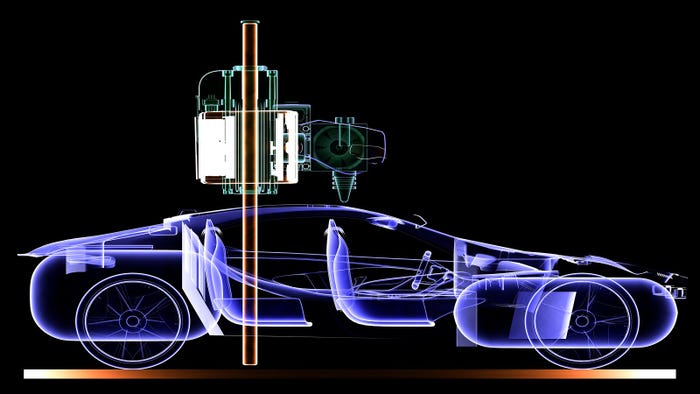
One exhibit in the DuPont booth will show the Xenon Dynamic Bending Light (DBL), from automotive lighting expert Valeo. It’s an adaptive headlamp system that optimizes illumination of road curves at night-time through use of a bi-functional elliptic projector headlamp, together with an electronic actuator and electronic control unit. Controlled by a microcontroller linked to the vehicle’s data network, the system operates the swiveling of the lamp by up to 15º more than the standard “straight-ahead” position. Designed for medium- to high-speed driving in both high and low beam mode, the system doubles the driver’s visibility distance in road curves, and maximizes his forward visibility.

A glass-reinforced and heat-stabilized grade of Zytel HTN PPA was used to create the headlamp housing because it offers high stiffness even at temperatures of around 150ºC, and hydrolysis resistance at 130-150 ºC for 95% RH. The lamp is available in vehicles such as the Citroen C4 or the VW Passat.

Also on display will be new applications for electroluminescent plastics. Engineers at a Bayer subsidiary called Lyttron Technology are exploring applications for films that light up when they receive an electric current. Until recently, this affect could only be achieved with flat surfaces. The new Bayer film, however, can be molded into any shape.

“We are targeting the automotive industry as one of the largest markets,” comments Thilo-J. Werners, CEO of Lyttron, which was created last year. “One key potential area is the interior lighting of clove compartments.” Another possibility is cell phones. A Bayer exhibit at K 2007 will show a demonstration off-road vehicle in which touch panels are made of a transparent polycarbonate that has been coated with electrically conductive Baytron P polymer to trigger the switch functions. The displays were developed by a Swiss company called Kaba that specializes in safety and closure systems.

Advertisement

Sponsored Content

Technology Marketplace

Gallery »

Plastic Breakthroughs Emerge for K 2007

Look for new ideas at K 2007, ranging from metal hybrid structures to engineering biomaterials

Email
Print
Reprints/License
RSS
Article tools sponsored by
Find a supplier on oemsuppliersearch.com

Talkback


We would love your feedback!


» Submit talk back
Advertisement
Advertisement

Design News Partner Zones

AnarkCAD/CAE Model Clean-Up: Reduce Iterative Cycles
This webinar featured research and survey results related to problems associated with preparing CAD geometry for CAE applications.  We discussed how Recipe-Based Automation can help create "just-in-time" CAE-ready geometry each time a cad model is updated. Watch the Presentation


Light Matters: Systems Level Approach to HBLED illumination applications
Its good practice to apply a systems-level approach to high-brightness LED (HBLED) illumination applications. Minimally, the system includes the optical, thermal and electrical characteristics of the of the HBLED, the lens (if any) which is built-in to its package, secondary optics such as external plastic lenses/reflectors to direct the light as your application requires and power driver electronics. Read More


Design Engineers' Portal for Sensing and Machine Safety
Whatever industry you're in, or whatever product you manufacture, the right sensors to automate your plant, and to improve your overall efficiency, quality and safety are a must. You'll find Banner Engineering to be an amazing resource of products, training and people with expertise.

Design News Partner Zone Directory »

Please visit these other Reed Business sites