Log In   |  Register Free Newsletter Subscription
Skip navigation
Zibb
Subscribe to Design News
RSS
Reprints/License
Print
Email

Alcoa Aluminum Shines in Sequel

New aluminum technologies are used in hydrogen fuel cell-powered Chevy Sequel SUV

Doug Smock, Contributing Editor -- Design News, April 29, 2007

The drive to make cars and trucks lighter and more fuel efficient is having a profound effect on materials development. Automotive engineers discussed progress with new dual-phase steels last month at a conference in Troy, MI.

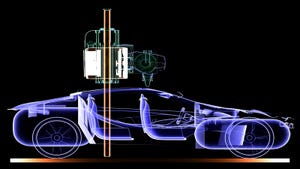
Aluminum is not asleep at the wheel either. Alcoa is providing structural design, engineering and manufacturing expertise for the Chevrolet Sequel, which General Motors believes is the most technologically advanced vehicle ever built. It features a hydrogen fuel cell power system as well as drive-by-wire, in which traditional mechanical and hydraulic control systems are replaced with electronic control systems. GM is looking to high-tech aluminum to dramatically reduce body weight, showing that SUVs can survive in a global warming environment.

More than 300 aluminum structural components have been produced by Alcoa at its R&D center in Lower Burrell, PA for the bodies in white for the Sequel. Body in white refers to the car body before the motor, chassis and trim are added.

The work includes development of newly engineered aluminum sheet for stampings, high-integrity castings and complex, multi-hollow extrusions for body-in-white and chassis structures. Sheet was specially formulated for use in GM’s forming process called “quick plastic,” which is an advanced hot blow forming process developed by GM and the U.S. Department of Energy. The process increases the formability of special aluminum alloys, resulting in production of integrated net shape components. Because part count is reduced, aluminum may be able to replace steel at competitive costs. The net benefit is a 40 percent weight savings.

It’s one of the key cards aluminum will play in its battle to increase market share in tomorrow’s vehicles, and the Sequel is the test bed. Alcoa is also supplying large blanks for the Sequel's outer body panels, as well as cast front and rear sub-frames. As is the case with the new advanced steels, significant work is also required in areas such as assembly. Specific targets in the Sequel project are welding, self-piercing and blind rivets and adhesive bonding.

The Sequel was first shown by GM as a concept car two years ago, and a drivable prototype was announced last fall when GM said the car would be branded as a Chevy. The Sequel uses clean, renewable hydrogen as a fuel and emits only water vapor.

“Sequel fundamentally changes the DNA of today’s automobiles … exchanging an internal combustion engine, petroleum and mechanical systems for fuel cell propulsion, hydrogen and electrical systems,” says Larry Burns, GM’s vice president of R&D and strategic planning.

The Sequel is now more than just a for-show concept car for General Motors. It’s a car the company intends to place into production. Considering financial, political and technical demands, it may be 10 years before you can actually drive one, however.

“Quick plastic” forming and other new aluminum technologies are used in the hydrogen fuel cell-powered Chevy Sequel SUV to cut weight and boost mileage. It emits only water.
RSS
Reprints/License
Print
Email
Reed Business Information Resource Center

Featured Company


Most Recent Resources

Advertisement

Sponsored Content

Technology Marketplace

More Content
  • Blogs

Doug Smock

Engineering Materials

Doug Smock
December 30, 2009
Long-Fiber Thermoplastics Are Hot
One hot growth area for thermoplastics in the next few years will be long fiber...
More

Doug Smock

Engineering Materials

Doug Smock
December 24, 2009
Boeing Grabs Another Piece of Dreamliner 787 Supply Base
As reported here previously, an extended supply chain has created engineering and...
More

Doug Smock

Engineering Materials

Doug Smock
December 22, 2009
ANL Converts Waste Plastic Bags into Carbon Nanotube Batteries
“Upcycling” is the big idea today in green circles. It’s the...
More

VIEW ALL BLOGS RSS

MechatronicsZone Promo
Advertisement
Texas Instruments Video Exclusives
eNewsletters
Gadget Freak
Sherlock Ohms
Made by Monkeys
Design Tools
Electronics/Test
Sensors/LED
Mechatronics
Motion Control & Fluid Power
Materials & Fastening
Special Technology Reports
International Engineering


Please read our Privacy Policy

About Design News   |   Advertise with Design News   |   Site Map   |   Contact Us   |   Subscription   |   Affiliate Links   |   RSS
© 2010 Reed Business Information , a division of Reed Elsevier Inc. All rights reserved.
Use of this Web site is subject to its Terms of Use |  Privacy Policy
Please visit these other Reed Business sites